
With the intense tune ofEye of the Tigerplaying in the background, it is time to for this showdown to begin. In the left corner we haveVerilog. Born in 1984, it didn’t make it to the big scene until 1995. In the right corner we haveVHDL, the language created by the US Department of Defense in the 1980’s.
Many people have different opinions on which language is better, but it really comes down to which language you prefer. I should also mention that there is of course System Verilog, but it is very closely related to Verilog so we’ll just leave that for another day. Let’s take a look at these languages and see what the differences are.
VHDL stands for VHSIC Hardware Description Language and VHSIC stands for Very High Speed Integrated Circuit. So on the whole VHDL actually stands for Very High Speed Integrated Circuit Hardware Description Language. Now, that’s a mouthful if I ever saw one! One of the key features of VHDL is that it is a strongly typed language, which means that each data type (integer, character, or etc.) has been predefined by the language itself. All values or variables defined in this language must be described by one of the data types.
VHDL is more verbose than Verilog and it is also has a non-C like syntax. With VHDL, you have a higher chance of writing more lines of code. VHDL can also just seem more natural to use at times. When you’re coding a program with VHDL, it can seem to flow better. But maybe that’s just my personal opinion.
在Verilog语言是更紧凑,Verilog language is more of a hardware modeling language. You will end up typing few lines of code and it draws similarities to the C language. Verilog has a better grasp on hardware modeling, but has a lower level of programming constructs. Verilog is not as verbose as VHDL so that’s why it’s more compact. All in all, Verilog is pretty different from VHDL. There are some similarities, but they are overshadowed by their differences.
查看此示例代码,我们可以比较如何通过VHDL和Verilog对MUX进行编程。
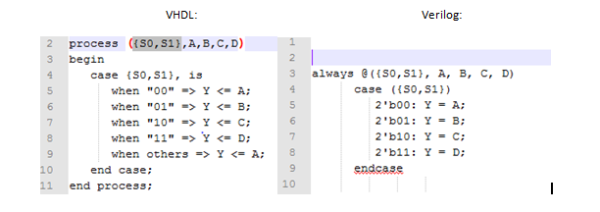
The layout of these programs are very similar; you can reasonably follow what each version of the code is doing. The VHDL version is longer then the Verilog, but it can be understood better.
这场比赛的最后一场比赛是无法轻易决定的……这是个人喜好挑战。这是读者的。权衡您为什么喜欢每种编程语言,以及最喜欢哪种语言。这是一个很好的机会,可以分享一些初学者在开始拿起VHDL或Verilog时应注意的东西的见解。如果您想查看任何一种正在行动的语言,请查看我们所拥有的一些学习项目VHDL和Verilog!
Also check out some of our popular projects that use each language. Kaitlyn, a longtime supporter of Verilog details on Instructables some of the awesome things you can do with this powerful tool.
This includes controlling servos on your FPGA!Hereshe demonstrates how she used theBasys 3和Verilog to control the motion required for theClaw Game Demo.

However despite a strong showing from Verilog, VHDL is not so quick to be outdone.Hereyou can see it in action being used to program the popularPmodJSTK.
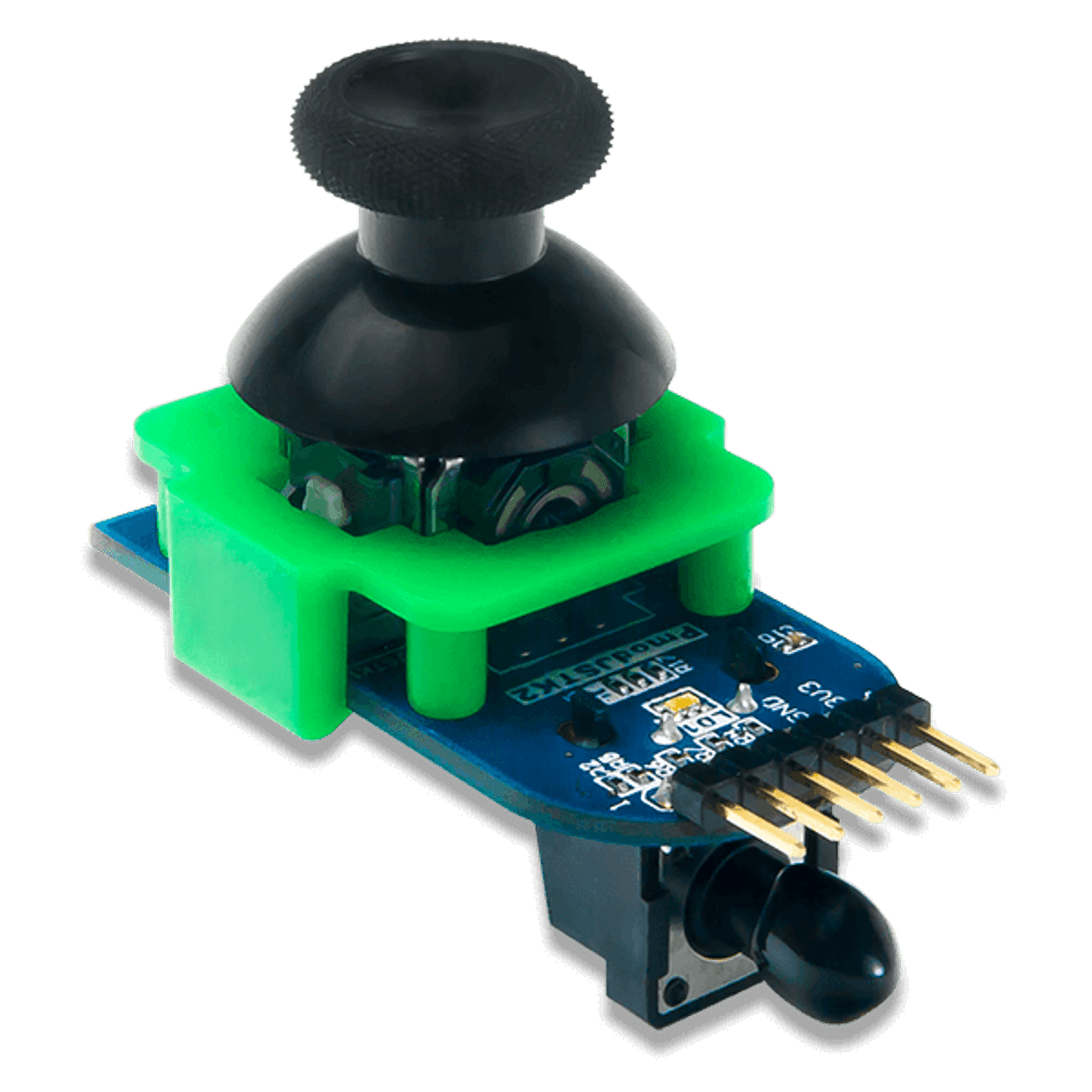
This Pmod can then be used for a variety of applications…some even battle-related.

Check out more on the PmodJSTK powered Jousterhere!


I was a little confused at first when I read your statement that while you are using VHDL you will have a tendency to write more lines of code but have it seem to flow better since that’s somewhat counter intuitive–instead of being quick and to the point, being long-winded is better?
But knowing that the reverse tends to be true (more lines of code equating to more clarity) for coding and looking that the VHDL to Verilog comparison for a MUX, I can definitely see how the VHDL makes a little more sense, even to the untrained eye (at least I think it does).
hey,
i am my self mostly programming in VHDL.
I would like to point out that the MUX example showed in the article, in Verilog can be very similar to VHDL only by adding 2 more lines that are not most in the example, BUT CAN BE(!!)
[email protected](…)
begin//the first line, like ‘begin’ in VHDL
.
.
.
end // like ‘end process’ in VHDL.
Hi,
thanks for the article.
You might also want to read the article from Mr Gaisler called ‘A structured VHDL design method’
(http://www.gaisler.com/doc/vhdl2proc.pdf)
Mr Gaisler is not comparing the two languages, rather proposing a design methods compared to ‘dataflow’ design for VHDL which is interesting.
Kind regards,
LS
I have used both. I am one of the few who prefers VHDL over verilog. VHDL provides more in when you are creating generic designs compared to Verilog. Please don’t argue on this point because it is a fact. Verilog has some strange quirks that individual vendors try to correct in their implementations. VHDL is better defined and you are less likely to get bitten because you understood something wrong. It just is better defined than Verilog. In fact Systemverilog was created to make Verilog like VHDL. Instead SystemVerilog is a hodge-podge mess.
In the mux example, in Verilog you should write “always @*”. This gives you two things:
1. The inputs to the process are implicit and allows the tools to find them. No more risk of missing stating an input causing latches.
2. You indicate to the tool(s) that the process is combinational. This makes it easier for the tool to find problems and warn you.
This concept was further developed in SystemVerilog into the “always_comb” and “always_ff” statements.
因为您在谈论语法。可能值得指出的是,VHDL是不敏感的。这使得在所有大写字母中写陈述基本上是VHDL的标准,这使得它越奇怪。这使得代码更难阅读。
Fix your VHDL example code.
VHDL does not have {A, B} syntax. In the process sensitivity list you can use just (S0, S1, A, B, C, D).
The concatenation would look like S0 & S1. However, you cannot use it in the case statement. Create a variable before, say S, and assign it the value S := S0 & S1. Then do “case S is”.
We have a reference app that provides all the keywords of both VHDL and Verilog, notes the equivalent in the other language (when they exist), and gives a simple usage example.http://www.squishlogic.com/VHDLRef/
I have to completely disagree that VHDL reads better than Verilog in your MUX example. There is double the punctuation.
As someone having to learn VHDL coming from SystemVerilog, VHDL syntax is just silly and absurd. Perhaps I just have more experience in SV and C, but the way SV modules are constructed just make more sense to me. Something being more verbose does NOT make it easier for me to understand. I prefer compact designs.